HEMLOCK VINTAGE CLOTHING
CART
Dresses
Antique
Separates
Suits
Outerwear
Lingerie
Shoes
Accessories
Men's
Discount
Patterns
Jewelry
Sitemap
The Bias Cut
Hemlock Vintage Clothing's
Fashion In History
PART I


The Bias Cut: Madeleine Vionnet

        One of the most important elements of 1930's fashion is the bias cut. Introduced by the French Couturier Madeleine Vionnet in 1927, the bias cut defined both women's day and evening wear of the 1930's.

The formal definition of bias cut, presented in Ellie Laubner's Collectible Fashions of the Turbulent 1930s, states that "pattern pieces are turned vertically so that the warp and weft threads are both on the diagonal." This technique of sewing the fabric at angles created a "natural elasticity" (1). Unlike the loose straight-lined fashions of the 1920's, the bias cut allowed fabric to cling to the contours of the body. This clinging effect gave clothing a sleek and elegant look. While many designers sought to conceal a woman's chest, waist and hips in the 1920's, the bias cut helped reintroduce curves into popular fashion.


Madeleine Vionnet at work, late 1920s.

         Vionnet opened her first salon in 1912, which she ran on and off until 1940. She did not create designs on paper, but rather experimented with her ideas by draping cloth on a half-size mannequin placed on a revolving piano stool (2). She cut and draped her fabric "in the round" by turning the stool and wrapping the fabric around the mannequin. This draping of fabric around the body is reminiscent of a Classical Greek figure's draped and fluted sheer clothing (3). Vionnet ingeniously arranged the fabric folds into complex and elegant designs. For example, she created various shapes such as triangles, diamonds, and lozenges from pin tucks. These shapes were positioned in rows of graduated sizes in such a way as to mold the fabric to the contours of the body (4). Vionnet's inventive manipulation of fabric and intricate yet subtle designs set the stage for 1930's fashion.

        Although more curvacious, Vionnet's bias cut designs still emphasized the slim figure popular in the 20's. Her clinging and revealing draped fabric demanded that a woman be tall and thin (5).

A Madeleine Vionnet dress. Titled Bas Relief, 1931, by Vogue photographer George Hoyningen-Huene.

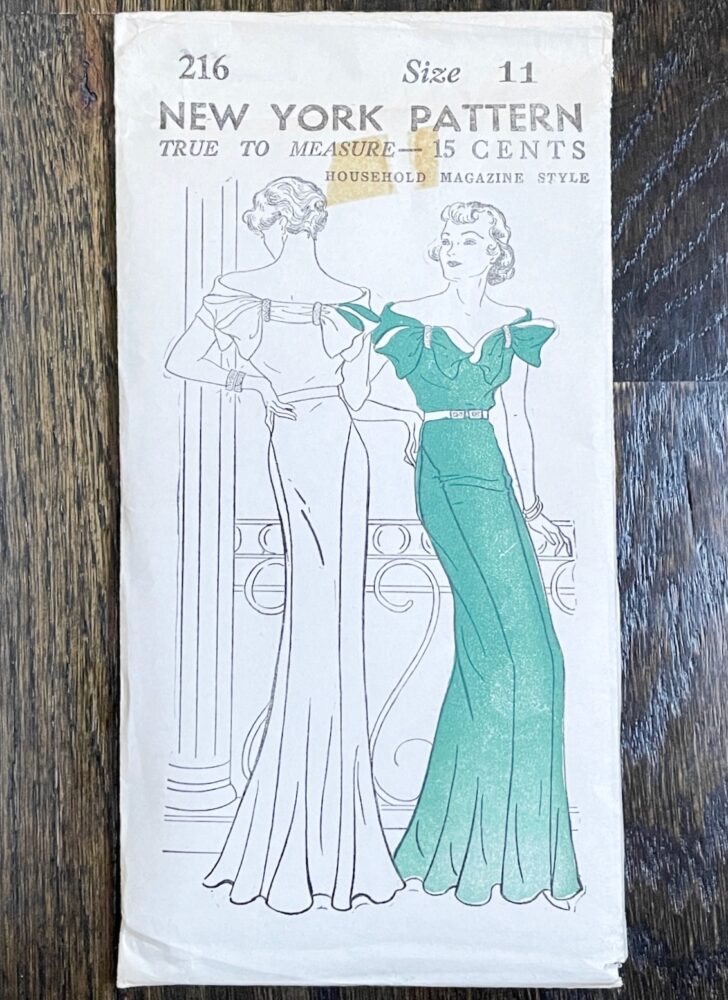
The typical bias cut dress was tight in the torso, had a slim waist and hips, and a belled skirt commonly accented with godets (6). Many bias cut gowns would swoop low in the back with a cowl or halter neckline. Delicate fabrics such as crepe de chine, chiffon, satin, lame, lace, mousseline de soie, charmeuse, rayon, georgette and silk velvet were used to create the bias cut. These fabrics, in particularly the sheer styles,

were often too revealing to conceal a corset. One of the first designers of the 20th century to reject the corset, Vionnet felt that a woman should naturally carry off her designs. In effect, Vionnet's bias cut fashions were designed for a statuesque frame.

         In the mid-1930's, Vionnet adopted more traditionally romantic designs. She utilized tulle and gauze and designed dresses with wide skirts. As war and fascism gained momentum in Europe and Asia, more severe and utilitarian fashions began to appear. Even so, the bias cut gown retained its popularity for at least a decade, from its conception in the late 1920's to its waning in the late 1930's. The bias cut gown, the centerpiece of 1930's fashion, can be attributed to couture designer Madeleine Vionnet. With her innovation of the bias cut and elegant draped designs, Vionnet defined the direction of fashion in the 1930's.
1. Laubner, 27.
2. Laubner, 28.
3. Lehnert, 37.
4. Laubner, 28.
5. Lehnert, 38.
6. Lehnert, 34.
Laubner, Ellie. Collectible Fashions of the Turbulent 1930s. Atglen, PA: Schiffer Books, 2000.
Lehnert, Gertrud. A History of Fashion.Cologne, Germany: Konemann, 2000.

To read Part II, click HERE

© HEMLOCK VINTAGE, 2008. ALL RIGHTS RESERVED.